
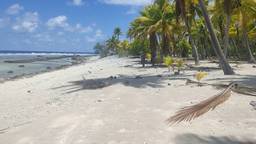
Village de Teana et lagon de Fangatau
VerifiedTuamotu, Fangatau, Teana
- Teana village Fangatau
- what to see in Fangatau
- Fangatau atoll Tuamotu
About
Fangatau is a small, isolated atoll in the eastern Tuamotu, about 900 km northeast of Tahiti, 150 km east of Raroia and 73 km west of Fakahina, the other atoll in the commune. Oval in shape, it measures about 8 km by 3.5 km and surrounds an 11 km² lagoon with no pass: a basin cut into the reef flat serves as access to the ocean. Russian explorer Bellingshausen reached it on July 10, 1820, and named it Araktchev after his ship; his compatriot Kotzebue visited on March 2, 1824. The island was once called Marupua: maru for shade, pua for the flower of the tou (Cordia subcordata), a tree highly valued on atolls for its wood and ample shade.
The roughly 135 inhabitants (2017) live almost entirely in Teana, the village built on the western side of the atoll. Its name, “te ana,” means “the cave”: it is said to come from the small cavities along the shore where fish used to hide, now replaced by the village’s protective seawall. Teana is striking for its well-kept, flower-filled gardens—bougainvillea, tiare tahiti, hibiscus, ti, uru, lemon trees—and for a few old wooden houses from the 1920s, such as the old presbytery, the former town hall and the Estall house, several of which are now in ruins. Three tou trees, probably more than a century old, stand along the road beside the seafront, lending honor to the island’s former name with their shade.
At the heart of the village, Saint-Dominique Church was built in 1872-1873, with woodwork prepared in Tahiti and brought by schooner, during the time of Father Montiton; nearby is a grotto of the Virgin Mary made of coral stones. South of the village, the Ramapohia marae, mentioned by Eugène Caillot, is said to have slabs with vaguely human shapes and to be linked to the Taputapuatea marae on Raiatea.
As for nature, Fangatau is the atoll of giant clams: the shallow eastern part of the lagoon forms a unique network of pools and shell ridges (the mapiko), characteristic of the closed atolls of the eastern Tuamotu, where yellow giant clams—and, more rarely, pink, orange or green ones—grow. Since 2001, giant clam farming for food and aquariums has provided a livelihood for some families. Seen from the sky, the turquoise lagoon and its white-sand beaches stand out against the coconut grove; on the ocean side, long beaches of sand and coral debris line the reef flat.
Practical information: the airfield (FGU), inaugurated in 1978 in the northwest of the atoll, receives a few flights a week from Tahiti, often via other atolls; supplies arrive by schooner. There is no bank or rental service: bring cash, water and sun protection; tap water is not potable. Stay on the streets and public shoreline: gardens, houses, coconut groves and giant clam farms are private or operated commercially, so ask before entering. Respect the church, marae and cemetery, do not collect giant clams, do not walk on living coral, and take your rubbish with you.
Photos: Google Maps contributors (listing “Fangatau”).